Machine
A cabinless chassis with industrial hydraulics and field-replaceable modules.

Our approach
We are developing our own heavy-equipment platform, with autonomy designed in from the start.
Designing the machine, sensing and controls together lets us simplify how the equipment is built, operated and maintained.
A cabinless chassis with industrial hydraulics and field-replaceable modules.
Mapped travel and pallet handling, with teleoperation for exception recovery.
Detection and safety controls designed to operate independently of the autonomy computer.
Owning the platform gives us a path to bring more components and manufacturing in-house as we grow. We are building toward becoming an original equipment manufacturer, developing the machine, autonomy and production together.
Physical observability
A physical observability layer represents the site’s materials, equipment and layout in a shared model. We are developing it to support task planning, world model training and site tracking.
Represent the layout and objects that a material-handling task depends on.
Use site structure and variation as context for autonomy development.
Connect the location and state of materials to the site model.
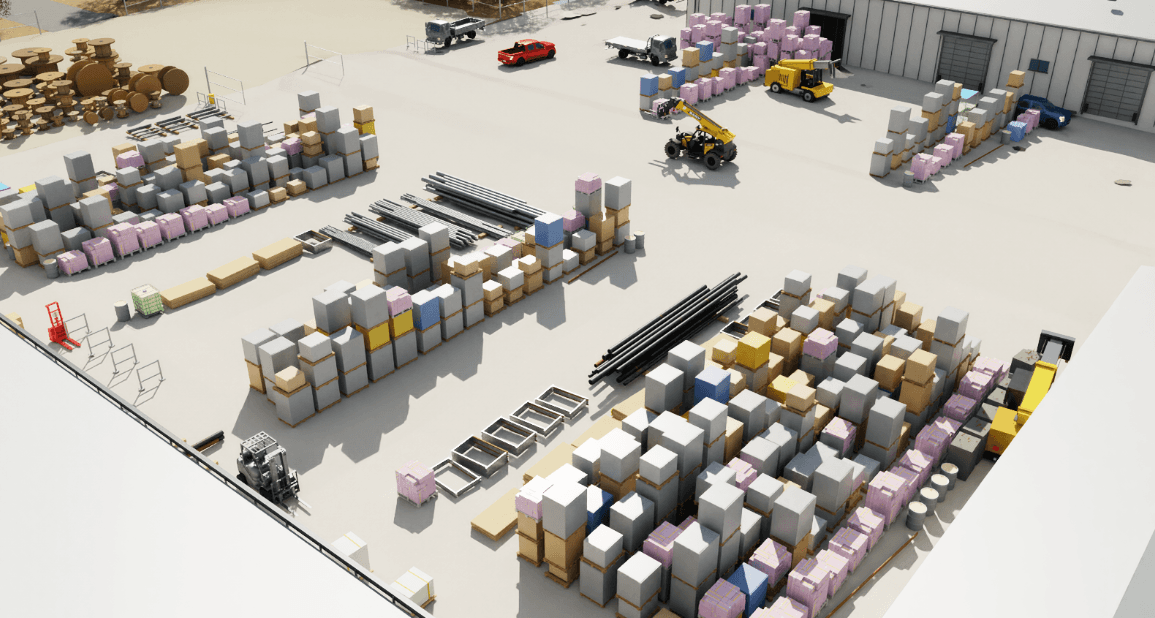
Our Real2Sim work connects physical site information with a simulation environment for autonomy development. The laydown yard below shows the setting in which that work is being developed.